
Feeding Cannabis Without a Chemistry Degree: What Plants Need, and When
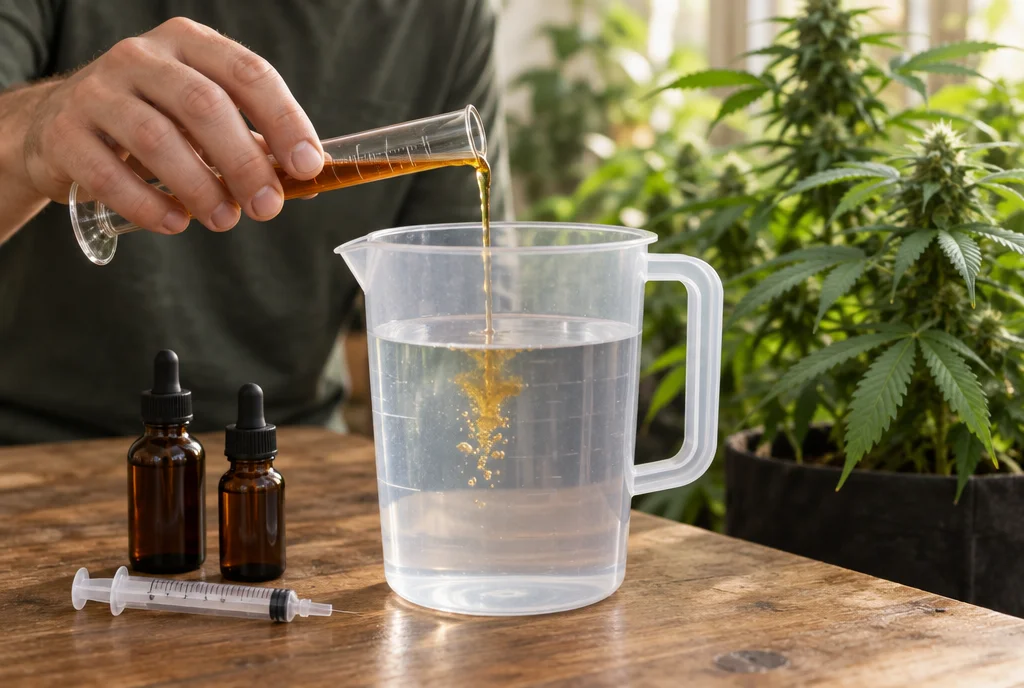
Turn over any bottle of cannabis nutrients and you’ll find a feeding chart: weeks across the top, several products down the side, and a number of milliliters per liter in every cell. Measure them out in the right order, check the pH, adjust it, and do it all again a few days later. No wonder feeding is where so many new growers feel lost.
The good news is that the principles are simpler than the charts make them look.
What a Cannabis Plant Eats
Plants need three main nutrients in large amounts, usually written as N-P-K on the label:
- Nitrogen (N) builds leaves and stems. It’s the engine of vegetative growth.
- Phosphorus (P) supports roots, energy transfer and flower formation.
- Potassium (K) helps regulate water inside the plant and drives flower development.
On top of those, cannabis needs secondary nutrients like calcium, magnesium and sulfur, and tiny amounts of micronutrients such as iron, manganese and zinc. A shortage of any one of them can hold back the whole plant.
The Diet Changes as the Plant Grows
A seedling needs only a very light feed. In the vegetative stage, the plant wants plenty of nitrogen for lush, green growth. Once it starts flowering, the balance shifts toward phosphorus and potassium to build buds. Feeding a flowering plant like a vegetative one, or the other way around, leaves yield on the table.
Why Nutrients Come in Part A and Part B
Many nutrient lines come as two separate bottles. That’s not a marketing trick. Some ingredients, like calcium, react with others, like sulfates and phosphates, when they’re concentrated together, forming solids the plant can’t use. Keeping them in separate bottles, and adding them to the water one at a time, keeps everything available.
The Most Common Feeding Mistakes
- Overfeeding. More isn’t better. Too strong a mix burns leaf tips and stresses the roots.
- Forgetting the pH. Adding nutrients changes the water’s pH, so it has to be checked and adjusted after mixing, every time. We explain why in pH and EC, Explained.
- Starting with the wrong water. Hard tap water already carries lots of minerals, which throws off the balance before you’ve added anything.
- Guessing the stage. Switching the diet too early or too late is easy when you’re going by a calendar.
How We Solved It for Sunday
We took the chemistry off your hands completely. Sunday uses a two-tank system: you pour fresh water into the first tank, and Sunday mixes each irrigation batch in the second. It doses the nutrients and adjusts pH and EC automatically, to exactly what your plant needs at its current stage, using the crop steering techniques of the expert growers we designed it with.
Your first grow kit includes Sunday’s nutrient kit: Part A, Part B, pH Up and pH Down. These nutrients are precisely formulated for automated dosing, which is what lets Sunday be so precise, so Sunday is designed to work with its own nutrient system. Each grow cycle, you simply swap the nutrient cartridges.
Because Sunday is a drain-to-waste system, the excess from every irrigation drains into a separate runoff container rather than going back to the roots, so salts can’t quietly build up over the grow.
The one thing still up to you is the water. For the best results, use distilled, reverse osmosis (RO) or soft tap water, and avoid hard water. The plant grows in premium coco coir, a clean, soil-free medium that gives the nutrient mix full control, and your first kit includes 4 liters of it.
The Takeaway
Feed lightly early, shift the balance as the plant moves into flower, always check the pH after mixing, and start with clean water. Those four habits solve most feeding problems before they start, whether you mix by hand or let Sunday do it.
Let Sunday do the growing
Sunday automates light, climate, watering and feeding, the way the pros do it. Join the waitlist to be first in line when pre-orders reopen.