
Coco vs Soil vs Hydro: Which Growing Medium Is Right for You?
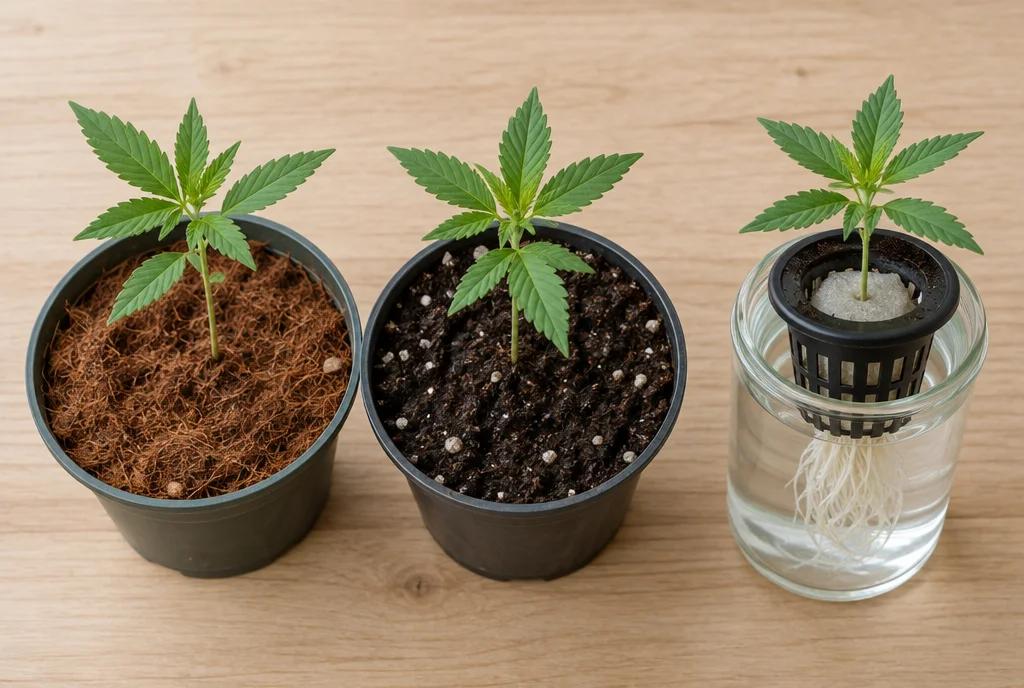
What your roots grow in shapes almost everything else about a grow: how often you water, how you feed, how fast the plant grows and how quickly a small mistake turns into a big one. Soil, coco coir and hydroponics can all produce excellent cannabis, but they ask very different things of the grower. Here’s how each one works, where each one shines, and where each one tends to go wrong.
What a Growing Medium Actually Does
Whatever you choose, it has four jobs:
- Anchor the plant so it stands up.
- Hold water between irrigations.
- Hold air. Roots breathe. They need oxygen as much as water, and roots sitting in a medium with no air pockets start to suffocate.
- Hold or deliver nutrients in a form the roots can use.
The three options split those jobs differently. Soil does a lot of the work for you, slowly. Coco gives the job of feeding to you, but gives you precise control. Hydroponics removes the medium almost entirely and puts the roots straight into the nutrient solution.
A useful point from the research: a 2025 review of growing media for cannabis found that the choice of medium strongly affects growth, rooting and yield, while cannabinoid concentrations are driven mainly by the plant’s genetics. In other words, the medium won’t change what your strain is, but it can change how much of it you harvest.
Soil: The Forgiving Classic
Most people start with soil, or more precisely, a bagged potting mix rich in organic matter. Many mixes come “pre-fed” with enough nutrients for the first weeks.
Why growers like it:
- It’s forgiving. Soil buffers swings in pH and nutrients, so one bad feed rarely causes an instant crisis. Most growers aim for a pH of roughly 6.0 to 7.0.
- It’s simple. Water, wait, water again. Early on, you may not need to feed at all.
- Flavor fans love it, especially growers who use organic “living soil.”
Where it goes wrong:
- Overwatering. Soil holds water for a long time. Water it too often and the air pockets fill up, the roots struggle, and fungus gnats move in. (We explain this in How Often Should You Water Cannabis?)
- Slow feedback. Because soil buffers so much, problems take a while to show up, and a while to fix.
- Less precision. It’s hard to know exactly what nutrients are available at the roots at any moment.
Coco Coir: The Professional’s Middle Ground
Coco coir is made from the fibrous husks of coconuts. It looks like soil but behaves very differently. Studies of coir as a growing medium describe it as lightweight and very porous, with lots of room for air, while still holding a useful amount of water, though its exact properties vary with the source and how it’s processed. On its own, it contains very little in the way of plant food.
Why growers like it:
- Roots get both water and air, which encourages fast, vigorous root growth.
- You control the feeding. Because coco is close to inert, what the plant gets is almost exactly what you give it. Most growers target a pH of around 5.8 to 6.2.
- It’s hard to drown. Coco drains well, so frequent watering, even several times a day, is normal and healthy.
- It’s renewable, a byproduct of the coconut industry.
Where it goes wrong:
- It needs feeding nearly every time you water. With no nutrient reserve, skipping feeds leads to deficiencies quickly.
- Calcium and magnesium. Raw coir is naturally high in potassium and low in calcium and magnesium, and its surface can hold onto calcium and magnesium. That’s why good coir is washed and “buffered” before use, and why coco growers use nutrients with plenty of calcium and magnesium.
- Salt build-up. Coco is usually grown drain-to-waste: you water until some runs out of the bottom, and that runoff carries away excess salts. Skip that and salts accumulate around the roots.
Coco is the medium of choice for many professional programs, including the Athena crop steering approach, because it responds quickly and predictably to how you water and feed. We explain why in The Athena Protocol, Explained for Beginners.
Hydroponics: Fast, but High Maintenance
In hydroponics, the roots grow in water, or in an inert material like clay pebbles, with nutrients dissolved directly in the water. The most common home setup is deep water culture (DWC): roots hang in a tank of nutrient solution while an air pump bubbles oxygen through it.
Why growers like it:
- Speed. With water, nutrients and oxygen always available, a well-run hydro system can grow plants very quickly.
- No dirt. No bags of soil to haul around or dispose of.
Where it goes wrong:
- Drift. The plant takes up water and nutrients at different rates, so the solution’s strength and pH change constantly and need checking and correcting, plus regular full reservoir changes. We explain why that matters in pH and EC, Explained.
- Warm water. Warm water holds less oxygen. According to US Geological Survey solubility data, fresh water at 20°C (68°F) can hold about 9.1 mg/L of dissolved oxygen, but only about 8.3 mg/L at 25°C (77°F) and about 7.6 mg/L at 30°C (86°F). Less oxygen means weaker roots, at the same time that root-rot organisms thrive.
- Root rot. Researchers studying commercial cannabis facilities in Canada and California identified several species of Pythium, a water mold, causing root and crown rot, and found that long periods of saturation made the disease worse.
- No buffer. If the air pump or the power fails, roots in still water can suffer within hours.
Side by Side
| Soil | Coco coir | Hydro (DWC) | |
|---|---|---|---|
| Forgiveness | High | Medium | Low |
| Typical pH target | About 6.0–7.0 | About 5.8–6.2 | Similar to coco, monitored constantly |
| How often you feed | Occasionally | Almost every watering | Constantly, via the reservoir |
| Growth speed | Moderate | Fast | Fast |
| Biggest risk | Overwatering | Underfeeding, salt build-up | pH/EC drift, root rot |
| Best for | Hands-off beginners | Growers who want control | Growers who enjoy tinkering |
How We Solved It for Sunday
When we designed Sunday, we chose coco coir with drain-to-waste irrigation, the method many commercial growers rely on, because it gives the most control. The catch with coco has always been the work: mixing nutrients, adjusting pH and watering precisely, often several times a day. So we automated that part.
Sunday has two tanks. You pour fresh water into the first. Sunday mixes each irrigation batch in the second, dosing its own Part A and Part B nutrients plus pH Up and pH Down, and adjusting the pH and EC for your plant’s current stage. The batch reaches the roots through drip lines, and the excess drains into a separate runoff container, so used water never goes back to the roots. Every feed starts fresh, so there’s no reservoir to drift.
Every day, Sunday measures how much runoff came out and adjusts the watering to how much your plant actually drinks. Its irrigation follows the Athena crop steering protocol, adapted to work with Sunday’s runoff detection. For power users, Sunday’s wireless pH & EC sensor can also measure the runoff’s chemistry, to fine-tune the mix even further.
Your first grow kit includes 4 liters of premium coco coir and a nutrient kit with Part A, Part B, pH Up and pH Down. For the best results, use distilled, reverse osmosis or soft tap water.
The Takeaway
Soil is the most forgiving, hydro can be the fastest, and coco sits in between: fast and precise, as long as you feed it consistently and let it drain. If you’re growing by hand, choose the medium that matches how much attention you want to give. If you want coco’s control without the daily mixing and measuring, that’s exactly what automation is for.
Let Sunday do the growing
Sunday automates light, climate, watering and feeding, the way the pros do it. Join the waitlist to be first in line when pre-orders reopen.