
The Athena Protocol, Explained for Beginners (and Why Sunday Is the Ferrari of Growing)
Ask a commercial cannabis grower how they get dense, heavy, consistent harvests, and sooner or later one name comes up: Athena. Athena’s crop steering program has become one of the most widely followed playbooks in professional cultivation. It’s also full of terms like “P1,” “dryback” and “substrate EC” that can make a beginner’s head spin.
This guide explains the Athena protocol step by step, in plain language. By the end, you’ll understand exactly what the pros are doing and why it works. And you’ll see why we call Sunday the Ferrari of growing: it takes that race-bred program and puts it in a box anyone can drive.
What Is the Athena Protocol?
Athena is a nutrient company that published a detailed, stage-by-stage program for growing cannabis in soilless media like coco coir and stone wool. It covers nutrients, climate and, most importantly, irrigation. The heart of it is crop steering: using water, nutrients and climate on purpose to push the plant toward the kind of growth you want at each stage.
Think of a plant as having two modes:
- Vegetative mode: building the “body” of the plant: leaves, stems, branches and roots.
- Generative mode: putting energy into reproduction, which for cannabis means flowers.
A plant always does a bit of both, but you can nudge the balance. Gentle, comfortable conditions say “keep growing.” Mild, controlled stress says “time to reproduce.” Crop steering is the art of sending the right signal at the right time, like a driver choosing when to accelerate and when to brake.
Three Words You Need First
Before the protocol makes sense, you need three terms. They’re simpler than they sound.
Field capacity is the wettest your growing medium can be and still drain properly. Athena defines it as the point where runoff begins and the medium settles after draining. Picture a sponge you’ve soaked and then let drip: that’s field capacity.
VWC (volumetric water content) is how much of the medium’s volume is water, as a percentage. If a pot of coco at field capacity is 60% water by volume, its VWC is 60%.
Dryback is how much the medium dries out between waterings, as the plant drinks and water evaporates. Athena measures dryback relative to field capacity. Here’s the formula, with an example:
- Your coco holds 60% VWC at field capacity.
- You want a 30% dryback.
- Target = 60% × (1 − 0.30) = 42% VWC.
So you let the medium dry from 60% down to 42% before watering again. Small drybacks keep the plant comfortable and vegetative. Larger drybacks add mild stress and push it generative.
The Daily Rhythm: P0, P1, P2 and P3
Crop steering divides every day into four irrigation phases. This is the part of the protocol that sounds most technical, but it’s really just a daily routine.
P0: lights on, no water yet. When the lights come on, the plant starts photosynthesizing and drinking. Instead of watering right away, you wait and let the medium dry a little more. Athena suggests a small additional dryback of around 1 to 5% before the first irrigation. This wakes the roots up and gets them actively pulling water.
P1: the ramp-up. Now you water, but not all at once. P1 uses a series of small irrigations, called “shots,” spaced apart, until the medium is back at field capacity. Small shots soak in evenly. One big flood tends to run straight through the medium in channels, leaving dry pockets behind.
P2: maintenance. Once the medium is full, P2 keeps it there through the middle of the day. Each new shot roughly replaces what the plant just drank. How you water here also steers the plant: frequent small shots produce more runoff, which washes out salts and lowers the EC around the roots, while fewer, larger gaps let salts build up and raise it.
P3: the overnight dryback. P3 runs from the last irrigation of the day until lights on the next morning. This is the plant’s biggest dryback, and it’s your most powerful steering tool:
- To steer vegetative, water until close to lights off, so the medium stays moist overnight and the dryback is small.
- To steer generative, stop watering several hours before lights off, so the medium dries further overnight.
Then the lights come on, and the cycle starts again with P0.
Vegetative vs. Generative, by the Numbers
Here are the main levers the Athena program pulls, and which way they push the plant:
- Dryback. Athena’s handbook targets around 30 to 40% for a vegetative steer and 40 to 50% for a generative steer.
- Runoff. For a vegetative steer, Athena suggests higher runoff, about 8 to 16% of the water applied. For a generative steer, lower runoff, about 1 to 7%.
- Substrate EC. EC is the nutrient strength in the medium (we explain it in pH and EC, Explained). Lower substrate EC reads as comfort, so it’s vegetative. Higher substrate EC adds mild stress, so it’s generative. Runoff and dryback control it: more runoff flushes salts out, while bigger drybacks concentrate them.
- Climate. Warmer, more humid air is gentler. Cooler, drier air later in flower tightens the plant up and protects the buds.
The Athena Calendar, Stage by Stage
Now put it together. The Athena program changes direction several times during a grow. The numbers below are Athena’s published targets. They’re designed around Athena’s own nutrients, and flowering length always depends on the strain.
Vegetative stage (usually 2 to 4 weeks indoors). The goal is a strong frame and a big root system.
- Climate: 72 to 82°F (22 to 28°C), 58 to 75% relative humidity, a VPD of 0.8 to 1.0 kPa.
- Light: 18 hours on, 6 off, at a PPFD of 300 to 600.
- Feeding: pH 5.8 to 6.2, with input EC around 3.0 on Athena’s Pro Line. The handbook gives a substrate EC of 3 to 5.
- Steering: right after transplant, one large dryback of around 40 to 50% encourages roots to grow out in search of water. After that, small drybacks and higher runoff keep the plant vegetative.
Stretch (flower weeks 1 to 3). After switching the lights to 12 hours, cannabis can double in height. The goal is to control that stretch and set as many flower sites as possible.
- Climate: 78 to 82°F (26 to 28°C), 60 to 72% relative humidity.
- Steering: generative. Larger drybacks of around 40 to 50%, lower runoff and a higher substrate EC, which the handbook lets climb as high as 4 to 10.
Bulk (flower weeks 4 to 6). The flower sites are set. Now the plant needs to fill them out.
- Climate: 75 to 80°F (24 to 27°C), 60 to 70% relative humidity, a VPD of 1.2 to 1.4 kPa.
- Steering: back to vegetative. More moisture, more runoff, drybacks of around 30 to 40% and a substrate EC of around 3.5 to 6, so the plant can drink and feed freely while it builds weight.
Ripening (flower weeks 7 to 8, longer for some strains). The buds are finishing, and mold is now the biggest risk.
- Climate: cooler and drier, 65 to 72°F (18 to 22°C) and 50 to 60% relative humidity, a VPD of 1.3 to 1.5 kPa. Athena suggests going another 5 to 10% lower on humidity for especially dense buds.
- Steering: the plant is steered back toward generative for the finish.
Why This Is So Hard to Do at Home
Reading the protocol is one thing. Running it is another. To follow Athena properly, a commercial facility uses:
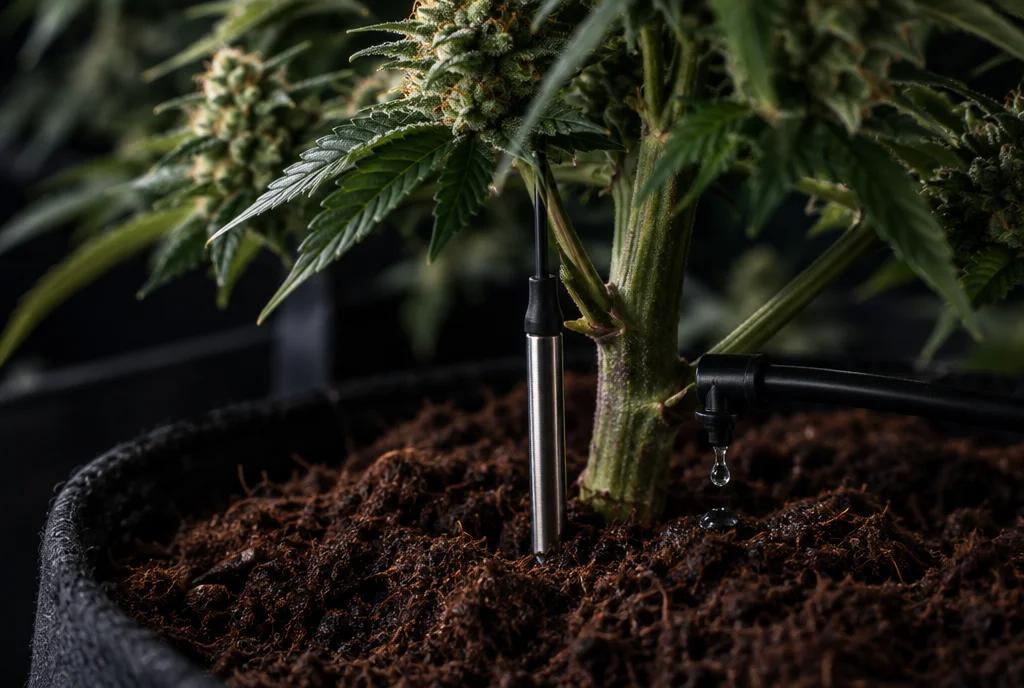
- Substrate sensors that read VWC and EC in the medium around the clock.
- Irrigation controllers that fire several precisely sized shots a day, timed to the lights.
- Dosing systems that mix every batch to the right EC and pH.
- Climate systems that hit different temperature and humidity targets for each stage.
- Growers who read the data every day and adjust.
For a home grower with a tent, it would mean watering several times a day at exact times, measuring dryback, checking runoff EC and changing strategy every few weeks. Almost nobody can do that around a job and a life. That’s why most home growers water on a schedule and hope.
Why Sunday Is the Ferrari of Growing
A Ferrari takes engineering developed on the race track and puts it in a car you can drive to dinner. You don’t need to be a racing driver to feel the difference. Sunday does the same thing for growing.
It runs the professional program. Sunday follows the Athena protocol: the daily irrigation rhythm, the drybacks and the stage-by-stage switches between vegetative and generative steering.
It adapts it to a home box. Commercial growers measure dryback with probes buried in the medium. We adapted the protocol to work with Sunday’s runoff detection algorithm. Sunday measures the runoff every day to see how much your plant actually drank, and uses that to set the next irrigations, so watering follows your plant instead of a fixed schedule.
It mixes every feed fresh. Sunday’s two-tank system mixes each irrigation batch from fresh water, dosing nutrients and adjusting pH and EC for the current stage, and delivers it to the roots through drip lines. The excess drains to a runoff container, so old water never returns to the roots. That drain-to-waste approach is exactly what crop steering needs.
It measures instead of guessing. Sunday’s wireless pH and EC sensor checks the mix and is easy to calibrate. Power users can also use it to measure the runoff, the same check commercial growers use, and fine-tune the mix to what the plant is absorbing.
It handles the rest of the program too. Its full-spectrum LED adjusts intensity to the growth stage and the plant’s height. Two fans and a humidifier pad on the intake shape the climate through each stage. Dual cameras watch the plant every 10 minutes.
It’s built from proven parts. Like any good performance machine, Sunday uses top-quality components from suppliers including Samsung, OSRAM, Netafim, Atlas Scientific, Kamoer, Mean Well and Espressif.
And just like a Ferrari, you don’t need to understand the engine to enjoy the drive. You plant a seed, close the door and start the grow from the app.
The Takeaway
Crop steering isn’t magic. It’s a set of signals: how much the medium dries, how strong the feed is, how much runs off and what the air feels like. The Athena protocol is the professional playbook for sending those signals at the right time, from root-building in veg, to controlling the stretch, to bulking and ripening the buds.
Even if a machine runs it for you, understanding these ideas makes you a better grower. You’ll know why your plant looks the way it does, and what “growing like the pros” actually means.
Let Sunday do the growing
Sunday automates light, climate, watering and feeding, the way the pros do it. Join the waitlist to be first in line when pre-orders reopen.