
Photoperiod vs Autoflower: Which Should You Grow?
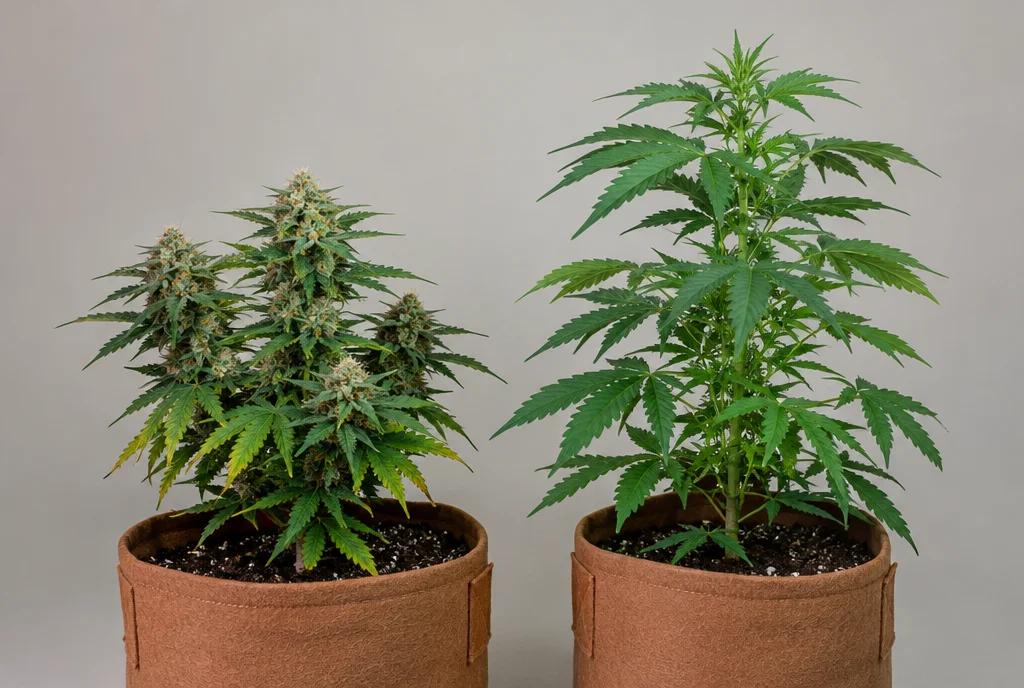
Before you buy your first seeds, you’ll have to make a choice most guides gloss over: photoperiod or autoflower? The two look similar in the pot, but they decide when your plant flowers in completely different ways, and that changes how long the grow takes, how big the plant gets and how much control you have along the way.
The Difference in One Sentence
A photoperiod plant starts flowering when the nights get long enough. An autoflower starts flowering when it reaches a certain age, no matter how much light it gets.
How Photoperiod Plants Work
Most cannabis is a short-day plant. Outdoors, it grows leaves and branches through the long days of summer and starts flowering in late summer and fall, when nights lengthen. What the plant actually measures is the length of the uninterrupted dark period.
Indoors, you control that clock. While the light runs for long days, often 18 hours on and 6 off, the plant stays in its vegetative (growing) stage, for as long as you like. When you switch to 12 hours of light and 12 hours of darkness, it starts to flower.
Twelve hours isn’t magic, but it’s a reliable default. A 2023 Australian study of medicinal cannabis found that a 12-hour day produced the fastest flowering, and that days longer than about 13.2 hours delayed flowering. Interestingly, some varieties yielded more under a 14-hour flowering day, so the ideal schedule depends on genetics. For a home grower, 12/12 is the safe choice.
Darkness has to be real darkness. Commercial flower growers deliberately switch lights on in the middle of the night, a trick called a “night break,” to stop short-day crops from flowering. In a cannabis grow, accidental light during the dark period, from a leaky tent, a hallway lamp or a phone screen, can confuse the plant in the same way.
How Autoflowers Work
Autoflowers are photoperiod-insensitive, also called day-neutral. Their flowering is triggered by age, not night length. The trait is believed to come from wild cannabis populations at high latitudes, sometimes called Cannabis ruderalis, where summers are too short to wait for long nights.
Cornell University researchers have mapped the trait to a single region of the genome, which they named Autoflower1, and confirmed that it behaves as a simple recessive trait: a plant needs two copies to autoflower. Plants with both copies are, in the researchers’ words, “photoperiod-insensitive and very early.”
In practice, that means:
- No schedule switch. Autoflowers can stay under the same long day, commonly 18 or 20 hours of light, from seed to harvest.
- A fixed clock. The plant starts flowering after a few weeks of growth, whether it’s ready or not.
- Shorter grows. Many autoflowers finish noticeably faster than photoperiod plants. Check the breeder’s listed timeline for the specific strain.
Pros and Cons
Photoperiod plants:
- Control. You decide how long the plant grows before flowering, so you can let it fill your space completely.
- Recovery time. If something goes wrong, from a feeding mistake to a pest, you can stay in the vegetative stage until the plant recovers.
- Training-friendly. Techniques like topping and SCROG need time, and photoperiod plants give you as much as you want.
- Clones. You can take cuttings from a favorite plant and grow the same genetics again.
- Downsides: longer grows, and you need a strict dark period during flowering.
Autoflowers:
- Speed. Shorter seed-to-harvest times mean more harvests per year.
- Simplicity. No light switch to manage and less sensitivity to light leaks.
- Compact size. Many stay small, which suits tight spaces.
- Downsides: the clock never stops. Stress early in life, like a seedling stall or a transplant shock, eats into the time the plant has to grow, and that can mean a smaller harvest. Heavy training is riskier, and cloning isn’t practical because a cutting keeps its mother’s age.
Which Should You Grow?
Choose autoflowers if you want the quickest possible harvest, you’re growing in a space where you can’t guarantee darkness, or you want a small plant with minimal training.
Choose photoperiods if you want the most control over size and yield, you want to train the plant to fill a wide space, you want room to recover from mistakes, or you’d like to keep a favorite strain going with clones.
There’s no wrong answer. Many experienced growers keep both around for different purposes. If you’re just starting out, the more forgiving of the two depends on your setup. Autoflowers are simple but unforgiving of early mistakes. Photoperiods ask for a little more management but give you time to learn. Keeping young plants healthy matters either way, and we explain the most common early problem in Why Seedlings Stall in Their First Weeks.
How We Solved It for Sunday
We built Sunday around photoperiod strains first, because they get the most out of what the box does well. Sunday runs the light schedule automatically, so the switch from growth to flowering happens at the right time without you setting timers. Its LED adapts its intensity to the plant’s growth stage and height, and the plant is trained wide under a SCROG net, which comes in your first grow kit. Feeding and irrigation follow a crop steering approach based on the Athena protocol, which we explain in The Athena Protocol, Explained for Beginners.
The extra time a photoperiod plant takes is time Sunday spends managing light, climate, watering, pH and nutrients for you. Most strains take about 8 to 14 weeks from seed to harvest.
Autoflowers aren’t supported yet. We’re actively working on adding them, and we’ll share news as it happens.
The Takeaway
Photoperiod plants flower when you say so, which gives you time, control and the option to clone. Autoflowers flower on their own clock, which makes them quick and simple but less forgiving. Pick the one that fits your space, your patience and how hands-on you want to be, and buy seeds from a breeder that clearly lists which type you’re getting.
Let Sunday do the growing
Sunday automates light, climate, watering and feeding, the way the pros do it. Join the waitlist to be first in line when pre-orders reopen.